AI is no longer just a futuristic buzzword; it is a practical, everyday teammate. AI agent assist solutions are transforming how people work by providing real-time guidance, automating routine tasks, and surfacing the right information at exactly the right moment. By leveraging these tools, businesses can significantly improve call center efficiency through AI. Instead of replacing humans, these intelligent assistants amplify human strengths and free teams to focus on higher-value work.
In today’s fast-paced work environment, integrating intelligent systems with cutting-edge distributed computing technologies that handle massive data processing efficiently can elevate operational efficiency. Organizations are also exploring advanced high-performance computing systems that accelerate complex problem solving to complement AI agent assist solutions, enabling teams to access insights faster and make better decisions with minimal manual effort.
For marketing teams, applying AI insights can transform campaign strategies. Using comprehensive strategies for online marketing that improve engagement and conversion rates allows businesses to connect with audiences more effectively. Additionally, adopting practical digital marketing techniques powered by AI-driven analytics tools can streamline repetitive tasks while providing actionable intelligence for smarter campaign planning.
Financial management also benefits from intelligent automation. Leveraging detailed financial planning resources and strategies for smarter business budgeting helps companies forecast, allocate, and manage funds efficiently while reducing human error. When AI agent assist solutions are combined with these specialized tools in technology, marketing, and finance, organizations create a seamless workflow that enhances productivity, reduces friction, and empowers teams to focus on strategic priorities instead of repetitive work.
Top 10 AI Agent Assist Platforms for Contact Centers in 2025
AI agent assist is transforming the way contact centers operate, helping agents provide faster, more accurate service while reducing repetitive tasks. Here’s a list of the top 10 platforms leading the market today:
1. Bright Pattern
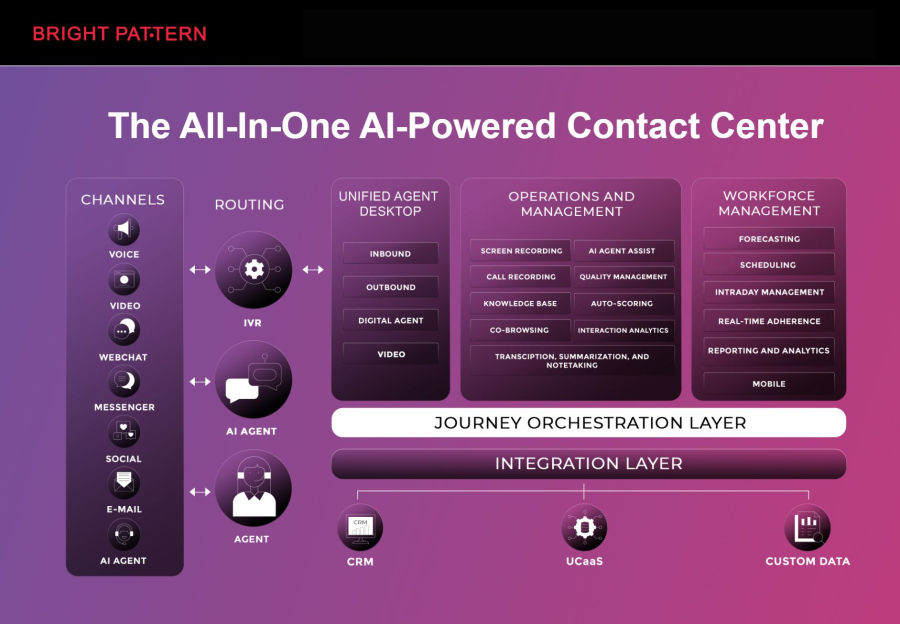
Bright Pattern is a leading AI agent assist platform that empowers contact centers to deliver seamless customer experiences. Its intelligent automation and real-time guidance tools help agents focus on complex interactions while routine tasks are handled automatically.
Key features of Bright Pattern:
- Omnichannel support including voice, chat, SMS, and social messaging
- Real-time AI guidance for agents during customer interactions
- Automated workflows that reduce repetitive manual work
- Advanced analytics and reporting to optimize performance
- Seamless integration with CRM and third-party software
Benefits of using Bright Pattern for AI agent assist:
- Improves first contact resolution by providing agents with the right information instantly
- Reduces average handling time while maintaining quality service
- Enhances agent satisfaction by minimizing repetitive work
- Supports scalability for growing contact centers

2. Genesys
Genesys offers AI-driven customer experience tools, including virtual assistants and AI agent assist features to enhance productivity and reduce wait times.
3. NICE inContact
NICE inContact provides AI agent assist solutions that help agents with real-time suggestions, automated routing, and analytics to improve overall contact center efficiency.
4. Talkdesk
Talkdesk AI helps contact center teams optimize workflows, provide contextual support, and integrate AI agent assist tools for enhanced customer experiences.
5. 8x8 Contact Center
8x8 offers AI-powered agent assist features that improve call handling, suggest next-best-actions, and automate routine tasks across multiple channels.
6. RingCentral
RingCentral integrates AI agent assist to streamline agent workflows, increase productivity, and provide actionable insights during live interactions.
7. Zendesk
Zendesk AI agent assist enhances support teams by delivering knowledge suggestions, automating repetitive tasks, and providing real-time guidance during customer conversations.
8. Amazon Connect
Amazon Connect provides AI agent assist capabilities that include intelligent routing, real-time transcription, and automated recommendations for agents.
9. Five9
Five9 uses AI agent assist to offer real-time guidance, automate repetitive tasks, and improve agent efficiency across multiple communication channels.
10. Salesforce Service Cloud
Salesforce Service Cloud incorporates AI agent assist tools that deliver predictive recommendations, automate workflows, and support agents with relevant knowledge in real time.
What Is AI Agent Assist?
AI agent assistrefers to intelligent software agents that work alongside humans to help them complete tasks more efficiently and accurately. Think of it as having a highly knowledgeable digital co-worker who:
- Listens to what is happening in a workflow or conversation.
- Understands context (customer history, policies, product details, and more).
- Suggests the next best action, response, or resource in real time.
- Automates repetitive steps, so people can focus on complex or human-centric work.
These assistants can appear as side panels in customer support tools, widgets in CRM systems, overlays on internal dashboards, or even as background services that trigger workflows automatically.
Why AI Agent Assist Matters Now
Teams today are under pressure to do more with less: more tickets, more customers, more compliance rules, and more channels. At the same time, customers expectfast, accurate, and personalized experiencesacross every interaction.
AI agent assist bridges this gap by:
- Reducing the cognitive load on employees who juggle multiple tools and data sources.
- Shortening learning curves for new hires who must master complex systems quickly.
- Standardizing quality by embedding best practices directly into daily workflows.
The result is a win on all fronts: faster operations, more confident employees, and happier customers.
Key Benefits of AI Agent Assist
Organizations adopt AI agent assist for many reasons, but several benefits appear again and again across industries.
- 1. Faster response times– AI can instantly suggest replies, forms, or actions, helping agents resolve issues in a fraction of the usual time.
- 2. Higher first-contact resolution– With context-aware recommendations and knowledge surfacing, agents get to the right answer on the first attempt more often.
- 3. Reduced training and onboarding time– New team members ramp up quickly when AI guides them through processes and provides just-in-time coaching.
- 4. Greater accuracy and compliance– AI can check for policy alignment, required disclosures, and data completeness, reducing human error and compliance risk.
- 5. Lower operational costs– By automating repetitive steps and boosting productivity, teams can handle higher volumes without a linear increase in headcount.
- 6. Better employee experience– Employees feel more supported and less stressed when they have an intelligent assistant to handle the heavy lifting and tedious tasks.
- 7. Actionable insights– AI agent assist systems capture rich data on workflows, friction points, and common questions, helping leaders improve processes continuously.
High-Impact Use Cases for AI Agent Assist
AI agent assist is flexible and can be deployed across many functions. Below are some of the most impactful and popular use cases.
1. Customer Support and Contact Centers
Customer-facing teams benefit significantly from real-time AI assistance. Typical capabilities include:
- Suggested responsesduring live chat, email, or voice interactions based on customer questions and history.
- Knowledge searchthat surfaces the most relevant article or policy snippet without manual browsing.
- Real-time coachingfor tone, empathy, and compliance as agents interact with customers.
- Automatic call summariesand ticket notes, saving time on after-call work.
The outcome is faster handling times, more consistent service quality, and higher customer satisfaction.
2. Sales and Customer Success
For sales and account teams, timing and personalization are everything. AI agent assist can:
- Recommendnext best offersor products based on customer profile and behavior.
- Highlightupsell and cross-sell opportunitiesduring live conversations.
- Generatepersonalized email draftsand follow-up messages instantly.
- Surfaceaccount health indicatorsso teams can proactively address churn risks.
Teams close deals faster, strengthen relationships, and unlock more revenue from existing customers.
3. IT Service Desk and Internal Support
Internal help desks often tackle repetitive requests such as password resets, access issues, and hardware questions. AI agent assist can:
- Diagnosecommon incidentsand recommend the appropriate resolution steps.
- Orchestrateautomated workflowslike account provisioning or system checks.
- Provideguided troubleshootingso technicians resolve issues quickly, even outside their specialty.
The result is reduced ticket backlogs, faster time to resolution, and less frustration for employees.
4. Operations and Back-Office Teams
From order processing to claims management, back-office workflows benefit from intelligent guidance and automation. AI agent assist can:
- Flagmissing or inconsistent databefore a record moves to the next step.
- Suggestrouting decisionsbased on workload, priority, and specialization.
- Automatically fillforms and templateswith extracted information from documents or systems.
This reduces rework, speeds up end-to-end processes, and improves quality control.
5. Knowledge Management and Training
Knowledge is only useful if people can find and apply it. AI agent assist helps by:
- Turning complex documents intosimple, conversational answerson demand.
- Identifyingknowledge gapsbased on recurring questions or escalations.
- Offeringmicro-coachingand just-in-time guidance instead of lengthy classroom sessions.
This transforms learning into an ongoing, embedded experience rather than a standalone event.
How AI Agent Assist Works (Under the Hood)
Although implementations differ, most AI agent assist solutions share a set of core components. Understanding them helps you plan a solid strategy.
Component | What It Does | Practical Benefit |
Data connectors | Connect to CRMs, ticketing tools, knowledge bases, and other systems. | Provide a unified view of relevant information without manual searching. |
Natural language understanding | Interprets user queries, customer messages, and conversation context. | Allows the AI to understand intent and respond appropriately. |
Reasoning and decision logic | Applies rules, policies, and workflows to decide on suggestions or actions. | Ensures guidance aligns with business standards and compliance. |
Generative capabilities | Drafts responses, summaries, and content in natural language. | Saves time on writing while keeping communication on-brand. |
User interface layer | Displays suggestions, guidance, and controls directly inside existing tools. | Minimizes disruption and encourages adoption through familiar workflows. |
Analytics and feedback | Collects performance data and user feedback on AI suggestions. | Supports continuous improvement and better decision-making. |
By combining these elements, AI agent assist provides context-aware support that feels natural within your existing environment.
Steps to Launch AI Agent Assist in Your Organization
Implementing AI agent assist does not have to be overwhelming. A structured approach helps you start fast while managing risk.
- Define clear goals
Decide what success looks like. Are you targeting faster resolution times, reduced onboarding, higher customer satisfaction, or all of the above? Quantify your goals with baseline metrics so you can measure impact later. - Choose high-impact workflows
Begin where the value is obvious, such as high-volume support queues or repetitive back-office tasks. Focus on processes with clear rules, structured data, and measurable outcomes. - Prepare and connect your data
Ensure your knowledge bases, policy documents, and process guides are reasonably up to date. Connect the AI to your core systems so it has access to the information it needs to assist effectively. - Design guardrails and policies
Define what the AI can and cannot do. For example, it might be allowed to draft responses but require human approval for certain decisions. Align guardrails with regulatory, legal, and brand guidelines. - Start with a pilot group
Roll out AI agent assist to a small but representative set of users. Collect feedback, monitor performance, and refine prompts, workflows, and knowledge sources based on real-world usage. - Scale and optimize
After validating results in the pilot, expand to additional teams, regions, or workflows. Use analytics from the AI to identify new opportunities for automation and assistance.
What Success Looks Like: Example Outcomes
Organizations across sectors are achieving measurable gains with AI agent assist. While exact numbers vary by context, typical improvements include:
- Customer support– A mid-sized service organization sees average handle time drop by around 20 to 30 percent when AI drafts responses and surfaces relevant articles.
- Training and onboarding– New hires reach target productivity weeks sooner when they rely on real-time guidance instead of memorizing procedures.
- Sales operations– Sales teams increase follow-up volume and quality when AI prepares personalized outreach, leading to higher conversion rates.
- Back-office processing– Manual data entry errors decrease significantly when AI validates fields and pre-populates forms.
Beyond the numbers, many teams report a noticeable shift in morale. When employees are supported by intuitive, intelligent tools, they feel more capable, more in control, and more engaged in their work.
Best Practices for Getting the Most from AI Agent Assist
To maximize value and ensure a smooth rollout, consider these proven practices.
- Involve frontline users early– Engage agents, sales reps, or operators in defining requirements and testing prototypes. Their insights will help shape solutions that are genuinely helpful.
- Focus on assistance, not replacement– Position AI as a teammate, not a threat. Reinforce that final decisions and relationship-building remain human-led.
- Invest in high-quality knowledge– The quality of your knowledge bases and documentation directly influences AI performance. Prioritize clarity, accuracy, and relevance.
- Monitor and iterate– Use analytics and feedback loops to refine prompts, tune guardrails, and expand coverage over time.
- Ensure transparency– Make it clear when content is AI-assisted and provide guidance on how users should review and adjust suggestions.
- Align with governance and security– Collaborate with legal, compliance, and security teams to define data handling rules and risk controls from the start.
Overcoming Common Concerns
As with any powerful technology, AI agent assist raises important questions. Addressing them directly builds trust and accelerates adoption.
“Will AI replace my job?”
AI agent assist is designed to enhance human work, not eliminate it. The technology excels at repetitive, data-heavy tasks, while humans remain essential for judgment, empathy, creativity, and relationship-building. Organizations that frame AI as a support tool typically see higher acceptance and better results.
“Can I trust the AI’s suggestions?”
Trust is built throughclear guardrails, rigorous testing, and human oversight. Early in deployment, it is common to require human review for all AI-driven actions. Over time, as performance is validated, some low-risk tasks can be automated more fully.
“What about data privacy and security?”
Responsible AI implementations respect privacy and follow strict security practices. Sensitive information should be protected through access controls, encryption, and clear policies on what data the AI can access and how it may be used. Collaborating with security and compliance teams from day one helps ensure alignment with internal and external requirements.
The Future of Work with AI Agent Assist
AI agent assist is a foundational step toward a more empowered workforce. Over time, assistants will evolve from reactive helpers into proactive collaborators that:
- Anticipate upcoming tasks and prepare the information or resources you need in advance.
- Continuously learn from outcomes to refine suggestions and workflows.
- Collaborate across departments, connecting insights from customer support, sales, product, and operations.
This shift enables organizations to build scalable, resilient operations without sacrificing the human touch that customers and employees value.
Conclusion: Turn AI Agent Assist into Your Competitive Advantage
AI agent assist is one of the most practical and impactful ways to leverage artificial intelligence today. By embedding intelligence directly into daily workflows, you help your teams work faster, with greater confidence and consistency.
Whether you are optimizing a contact center, empowering a sales team, or streamlining back-office processes, the core value is the same:humans and AI working togetherto deliver better outcomes than either could alone. With a thoughtful strategy, clear goals, and strong governance, AI agent assist can quickly become a powerful competitive advantage for your organization.
